I spent the first four semesters of art school trying out as many different mediums as I could. I learned that I hated large-scale sculpture (although at times therapeutic, it was more often than not frustrating, and resulted in awkward objects not easily stored or ever properly displayed) but liked small-scale. I'm drawn to mediums that don't require mathematical precision, but rather can take on charm in their flaws.
I love working in collage. However, I no longer have the time to sit in my floor, meticulously selecting scraps of paper, fingers covered in rubber cement, carpet perpetually filled with tiny paper shreds, slowly yet methodically filling up hardbound sketchbooks. (The collection has dwindled considerably over the course of several moves, but I still have a surplus of shoe boxes filled with interesting bits of paper, which many close friends will attest to loathing on move-in days!)
I have since relearned to love the quick accessibility and simplicity of drawing with ink. I love working with watercolor, and get very impatient with acrylic and oil. I also really enjoy using Adobe programs to enhance drawings, and drawings to enhance digital art.
•••I have been at Memphis College of Art for four years now,and for the first two, I had a very... absentminded advisor. This resulted in my taking a multitude of unrelated classes with no real plan in mind, hence the necessity of my fifth year. That being said, I'm just interested in a lot of different stuff. I think the most beneficial non-Illustration classes I've taken at MCA are as follows:
 Art of the First People: Mexico with Dr. Ramsey.
 Anyone who has seen my art over the past few years could guess this. Although the course itself is a little dry, it opened the door for me to a persistent aesthetic and conceptual obsession.
 Digital Imaging with Howard Paine.
 This was really the first class I had taken that allowed (and encouraged) work that was photographic, digital, illustrative, and all three combined. I did great work in this class.
Life Drawing with Fred Burton. I know that Drawing: Composition is a required course for Illustration students, but I think Life Drawing should be also. Exaggerated characters and cartoons can only benefit from a foundation of understanding the proportions of the human form.
 Forms of Fiction: Horror with David Burton.
 I really enjoyed this class because it basically consisted of reading great literature and talking in depth about it. We spent a lot of time decoding symbolism. I loved it.
Abnormal Psychology with Dr. Shaw. I feel like this class (along with its pre-requisite) really helped me with character development, scripting, body language, and dialogue with my ongoing comic.
Cultural Anthropology & Anthropology of Art with Deborah Halstead. Both of these classes are also very dry in their presentation, but intensely interesting, particularly concerning human behavior and relativity of normalcy.
•••I wouldn't say I have a particular modus operandiwhen it comes to what I make art about. I think that's kinda the beauty of being an illustrator--the freedom. It's not like being a fine artist working in series or a designer working commercially. Illustration falls into this odd shaped gap in the middle of the two, not limited to one medium or concept.

That being said I make a lot of work based on my interests. History, psychology, anthropology, and the aformentioned obsession with Mesoamerican and Mexican culture have/still are culminating into my ongoing "graphic novella". Human nature and human behavior also really interest me. I like drawing "odd-looking" people, and I like taking note of how my interpretation of "odd" changes.
I think the influence the work of my peers has had on me has remained consistent: I like watching them get better as I get better. Every student in the Illustration program right now has a completely unique style that has been carefully (yet also hurriedly) nurtured.
•••As far as music goes, I'm an emotion junkie. I've been listening primarily to the same five or six albums for years. I like familiar noises and words and actually have to be forced into listening to a new band. I hardly ever listen to music purposefully, as odd as that may seem.
•••Non-art related hobbies, interests, and skills.I'll try to condense this section.
I've been an avid writer for a long time. I always scored well on English exams, aced papers, and have kept a blog (&/or some sort of collection of writings) since age fourteen. I love writing, in all different forms too. This comic I have been laboring over for the past year is the first work of fiction I've attempted, however, and it's proving to be very challenging. I've also acted as the Senior Editor for the Black & White for going on four years now.

Of course, I started an arts collective my first year of college with a couple of other art students. I say "of course" not in an egotistical sense that you or anyone really should even be aware of our existence, but that if you know me, you know that it's such a big deal to me, I at one point chose to have a icon for it permanently inked into the skin of my wrist. Rozelle has afforded me a medium through which to do a lot of things and meet a lot of people I otherwise would probably not had the opportunity to do or meet. It's also put me in a position of responsibility for items of business I never would have expected, like financial planning, sponsorship, public relations, and event planning. Through that, I've also gotten a great taste of the business side of art-making and art-supporting. In all honesty, I'd be just as content with an organizational job in the arts as I would a real art-making career.
I've had some experience in other realms of the arts; I curated student exhibitions for the Brode Gallery at MCA for two years. I completed a curatorial internship with Power House Memphis a couple of years ago, and also aided in event planning, public relations, and private exhibition tours before they dissolved in 2009. I've worked for Indie Memphis overseeing the festival, organizing volunteers, and basically making sure the filmmakers and directors kept on schedule. I've worked on a few movie sets doing art direction and set dressing, also, through those contacts. I've sat in an empty silent gallery, bored, my fair share of hours.
But aside from that, I've worked in the food service industry since highschool; waiting tables, bartending, and catering. I like the work because no where else can a semi-intelligent, inexperienced twenty-something make three bills a night, and it reminds me why I'm in school--to avoid doing this as a career.
I think food service industry and administrative/organizational duties fall into the category of something I like that not many others do.
•••If I could own any three pieces of art in the world,they would be as follows:

Michael Jackson and Bubbles by Jeff Koons, 1988. This is one of the best sculptures ever created. Aside from the fact is solid porcelain and painstakingly goldleafed, it's just amazing. I think it's one of the most succinct works I know of that captures the pop culture-obsessed air of the 1980's; celebritizing meets idolizing.

An Olmec Head; specifically what's referred to as "Head 1" from the discovery in San Lorenzo. I love the sheer mass and bulk of the heads, the facial construction and feature exaggeration, but I especially love that they are shrouded in a lot of mystery as to who they are, why they were created, how they were transported, and what their purpose actually was. I like this one's face the most.

Surrogate by Patricia Paccinini. Because, I mean, look at this thing.






 The Hitchhiker's Guide to the Galaxy. That's an easy one. It's got some of the most badass descriptions of people, creatures, environments, processes, etc. of any book(s) I've ever read. It would pretty much take my entire life too.


 I found this guy David Downton over the summer. He does mostly fashion illustration; models, celebrities, actresses. He's got this ridiculously elegant way of composing a drawing. It's the kind of work that makes me jealous that I can't just sit down with a brush, slap down 7 or 8 perfectly placed lines and splotches of value, and emerge with a gorgeous ten-minute illustration (that I can then sell for the cover of this week's Vogue for a cool grand).
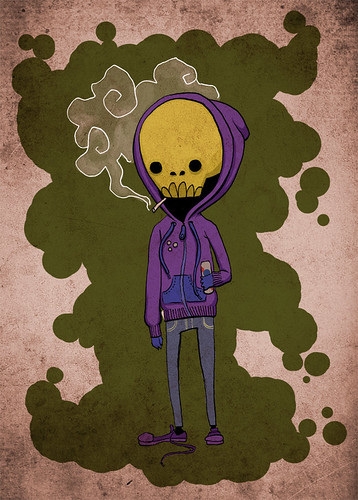
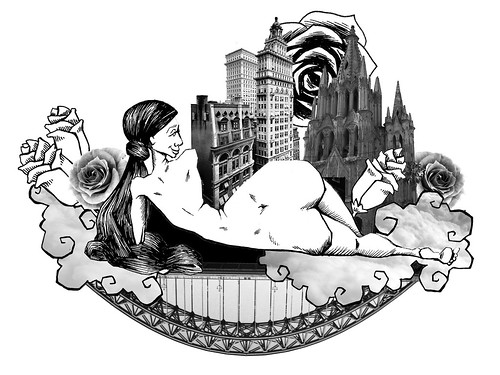
 Most people seem to like this print I made in Digital Printmaking last semester, probably because it's dark and creepy. I like it too though.
 I think my tarot card deck surprised me the most. I loved doing them, but I knew that doing 56 individual illustrations--particularly about a subject matter which is both very complicated and of which I knew very little about--was going to be difficult unless I spent most of the time researching the symbolism and condensing it into a simple image, and less of the time on the actual execution. In the final result, the nearly all of the illustrations were drawn at the print size, some even enlarged, which is not typical. They ended up looking simple, but not unfinished. I'm pretty proud of the way they turned out, and I'm still kicking myself for accidentally deleting the original PSDs...


 Art of the First People: Mexico with Dr. Ramsey. Anyone who has seen my art over the past few years could guess this. Although the course itself is a little dry, it opened the door for me to a persistent aesthetic and conceptual obsession.
  Forms of Fiction: Horror with David Burton. I really enjoyed this class because it basically consisted of reading great literature and talking in depth about it. We spent a lot of time decoding symbolism. I loved it.